Tuesday, August 9, 2011

Twisted Roots - Mather, Manitoba


Southwestern Manitoba was for awhile the home of my mother's family. After escaping from the Soviet Union in 1923 they settled in Gnadenthal, near Winnipeg, where her father purchased a farm. My mother was born there in 1927. With the onset of the Depression however the bank seized the farm for non-payment and the family drifted as economic refugees to less expensive land around Mather.

Mather today is a village with a stark broad main street of metal clad sheds purchased from catalogues. The original typical prairie town of wooden buildings running off the ubiquitous railway line was destroyed in a catastrophic fire in the late 1940s. Only a few charming old houses on well treed lots away from Main street survive from these early days. However the pioneers, and the now long gone railway, are commemorated in the pleasant green downtown.


Dad and I visited Mather to find family traces. We've no idea where the farm was but my Grandfather's grave, with its modest tombstone added by my mother in the 1970s, lies in the cemetery on a low hill a half mile from town.


Heinrich Albrecht married my grandmother in the fall of 1922, just six months after his first wife's dying. The previous five years had been hard with war, revolution and anarchy leading to starvation and destitution for millions in southern Russia and the Ukraine. Heinrich's first wife Aganethe bore five children, only two daughters survived these hard days. Sarah and Heinrich struggled to keep their family together and they left the chaos of a changing Russia for Canada.


After several years as a farmer Heinrich trained as a lay minister for the Mennonite church. Subsequently he traveled widely doing visitations and my grandmother, at home, managed the farm and looked after the by now four children, the older stepdaughters, Gredel and Annie, and her own children Henry (who I'm named after) and Helen (Mum). Their different paths lead to some interesting changes for in the late 1920s the title for the farm and all their property was transferred from Heinrich to Sarah.

Henry and Helen standing by the family horses as they are auctioned off.
The Depression crushed their farm life and was no better in Mather. In 1933 Heinrich died and Sarah sold what they had using the resulting cash to move to Winkler where their family life revolved around the garden, music lessons and school. However, when the money ran out even harder times followed.

An abandoned farmstead near Clearwater, Manitoba


Sunday, August 7, 2011

Working in Skagway

This spring I was invited to Skagway, Alaska to work with the US National Parks Service interpreters of Klondike Gold Rush National Historic Park. The park includes the town of Skagway, a charming restoration of the late 19th century landing point for gold rush stampeders, elements of the White Pass Trail and the start of the Chilkoot Trail, both challenging routes over the coastal mountains to the headwaters of the Yukon River. Although well versed in their part of the gold rush story, the staff were interested in the story Parks Canada tells in Dawson City, the capital of the Klondike gold fields.

They had arranged accommodation for me in the restored Baptist Mission Residence. Located near Skagway Creek with spawning salmon just beginning to run, it was also adjacent to the site of the old Pullen Hotel. The hotel, once the most luxurious place in Skagway during the tourist heydays of the 1920s, is marked now only by the two story stack of cobbles that made up the magnificent fireplace and chimney of the lounge.

The Mission about 1902.
One of the current darlings of Skagway is Sarah Palin. Her family lived in Skagway during Sarah's primary school years and she is a frequent, and popular, visitor in town. One of the town's business men smelled opportunity and opened the Sarah Palin Store. It carries a remarkable array of "tasteful" Palinesque material from her Going Rogue to fridge magnets and coffee mugs.


On my way home I experience another of nature's forces at the summit of the pass. The avalanche happened earlier in the winter but as the snow melts back the devastation and power is obvious.


Sam Magee Trail - A Place of Deceptive Fantasies

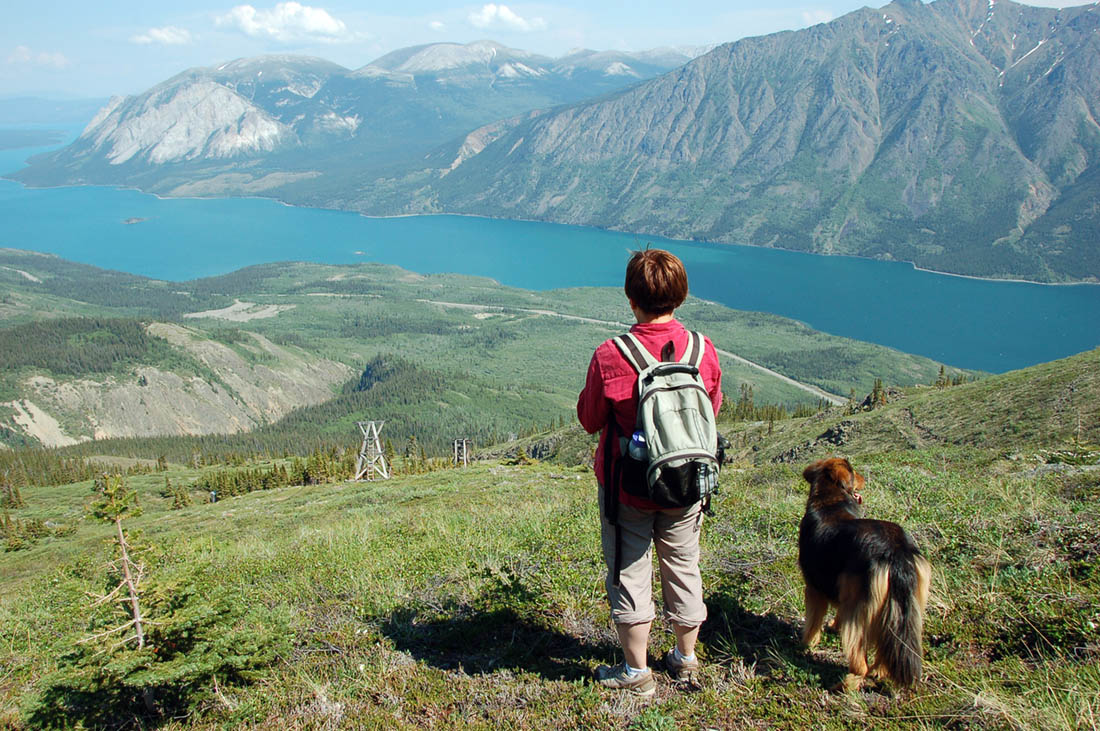
The Blue Moon hiking group overlooking Windy Arm. The miners working here in 1906 probably had few lovely days like this to enjoy, the mountain top is always windy and often wreathed in wet, cold fog.

The trail begins by following the line of tramway towers up the mountain, about half way up it joins the old horse trail that where the miners cut trees for mining timbers and fuel. The remains of their lumber camp are still there to explore.
Halfway up there is access to a small freshet in a shady niche where cold water is welcomed by everyone in our group.


Blue Moon hikers start young and just keep on climbing.


The string of tram towers up the mountain is impressive. The shareholders looking at photos of the operation in the early 20th century must've felt they'd made a sound investment with all the fancy gear. And while the system was manufactured and installed by reputable tram companies it is clear from a close look at how the mining company cut corners. All the towers are nailed together rather than bolted and none of the towers have foundations, they are simply built right on the ground. Sometimes loose rocks have been piled up to level out the tower. The other thing that is clear is that the system was little used, there is hardly any wear marks on the equipment. Looks good though.

Andrew planking towards Whitehorse.

Paula and her dog taking a last look before the descent to the lake.


Friday, July 8, 2011

Chilkoot Trail - Climbing on ice and relaxing

The Chilkoot Summit from our lunch spot. Still a kilometre to the base with a daunting 40 metres of ice climbing on all fours to reach the top.

Andrew and Joy with the Chilkoot Pass. Warm sunshine and reflecting snow toasted us through the day.

Joy and I relaxing amongst the wild flowers we worked so hard to visit.


Filling water bottles at Happy Camp.

We meet Christine, the longest serving trail warden, on the trail and trade some stories.

Katie relaxes in the tent museum and library at Lindeman City.

Bare Loon Lake, our last night, scene of the Thomas family banquet and a serenade of loons.

Waiting for the train at Bennett.
Bennett Lake reflections.

Katie, Greg and Andrew, still smiling on the way to Carcross.

Saturday, July 2, 2011

Chilkoot Trail: To the Summit


Joy on Heartbreak Hill, first hour of a five day hike. Andrew racing to catch up.


Hiking the Chilkoot appears to have become an annual event once again. We headed out a week earlier than last spring hoping for more snow to make the hike a little easier. Sometimes you get what you wish for but wish you hadn't. Our party of ten included a grouping of several families from across Canada, some experienced hikers and others new to both the trail and the art of backpacking.

A break and a smile along the trail.
Hiking the board walk over the beaver pond.
The weather was cool entering the rainforest and we enjoyed the spring wild flowers and the magical noise of the running water in the rivelets dropping down to the roar of the Taiya River at the bottom of the valley. At Canyon City, our first night, the sound of the river drowned out all else.

Andrew starting supper preparations at Canyon City
Bill and Mike

Janna and her trainee rescue dog Howard saved my bacon, well my knee actually, later in the hike.
Fran our Maritime sister shared stories of her hikes from around ther world.
Beyond our second night at Sheep camp we broke out of the rain forest and looked up into the mountains.
Trevor and Doug, our South African hiking buddies, were the last out of Sheep camp. They had a close encounter with a grizzly bear and were quite excited when they caught up to us and told us their story.
From the scales we could see the others climbing the Golden Stairs ahead of us. But we stopped to make hot soup and eat a hearty lunch before tackling the final climb to the summit.

Saturday, June 4, 2011

Voyage Home


For our trip back home we followed the traditional route, passenger ferry from Bellingham, Washington in Puget Sound and up the Inside Passage to Skagway, Alaska. Bellingham's port has remade itself has a trendy little community with a great bookstore, a selection of fine restaurants and an extensive network of walking trails. Cherry blossoms were the icing on the cake.


In summer the ferries are packed with enthusiastic tourists coming and going on their Alaskan adventure. But in spring and fall the ferry runs about 2/3 capacity, locals returning from a winter Outside or traveling between the coastal communities. The pace on the ship is relaxed and conversations run to chain saw modifications, the merits of different types of commercial fishing boats, job prospects in the timber industry, the fervent explanation of entrepreneurial dreams/prospects and, without fail, strong opinions on Sarah Palin.


The Kennecott, typical of the Alaska Marine Highway fleet, cannot be mistaken for  a cruise ship. The staterooms are modest and comfortable, the dining cafe home style, the bar folksy and recreational opportunities confined to a couple of pin ball machines and two second rate movies each day (at least the one I watched). The pleasure of the voyage rests within the comfortable lounges with their spectacular views of the coastal mountains, interesting conversations, relaxed reading and the chance to stand outside amid the sun, winds and spray of the Pacific Ocean's reach into the rugged coast of North America.

A few staffed lighthouses still operate along the Inside Passage. They look romantic on a nice day.

The fishing fleet at Ketchikan, Alaska. This was my first time in Ketchikan when it wasn't deluged with rain. The record annual rainfall is just over 5 metres. We actually had a sunny day. Everybody was in a good mood.
Early morning in Juneau. A view of the Mendenhall Glacier. We're only hours from home now.


Spring Travels - the big city


In March we traveled to visit family in Toronto. We stopped in Vancouver's Chinatown to visit our favorite Chinese bakery and enjoy a wander through one of city's the many interesting neighbourhoods. On these occasions  I wonder why we bother traveling further afield to see the world, a lot of it seems to have come to Vancouver.


While Vancouver's Chinatown also has its modern aspects, there is still a sense that it is a traditional Chinese place in Canada. Not a reflection of modern China but a representation of the place and time these people emigrated from. In Toronto the Oriental community, both new immigrants and Canadians from British Columbia, is newer and there are some adaptations to being Canadian.


 There is a lot of traffic in Toronto, Couldn't really get used to it.


Southern Ontario however does have its charms, not the least are the lovely women who live there. And once one leaves the confines of the metropolis the rural landscape of the Caledon Hills and the charming small towns that manage to maintain some control over their existence, offer alternatives to the modernist frenzy of conspicuous consumption. Fancy coffees and pastries are inconspicuous consumption so they don't count.