Wednesday, December 25, 2013

Lake Daniels Tramp and Maruia Hot Springs


The Alfred River winds through a cool and shady beech forest. Flowing into the Maruia River, the whole watershed is a remnant of the original forest of New Zealand and home to a number of endemic species.

The Lake Daniels tramping track following the river is part of a 45 km long trap line with nearly 500 rat traps. Self-resetting traps in heavy wooden boxes, each baited with an egg, were spaced along the track acting as a barrier for invasive species that threaten the unique bird life of the area.

During our tramp through the woods we felt it getting cooler through the day, sure signs of a Southerly - strong wet winds from Antarctica. When we reached the hut clouds covered the sky and we were glad to have some cover.

The common room of the hut includes a stove, benches, tables and counter space with sinks and running water - the lap of tramping luxury. And in mid-week we had the whole place to ourselves.

 
Two bunk rooms with comfortable mattresses flanked the common room. We opened the windows and laid out our beds. As I had forgotten the sleeping bags and liners in Christchurch, Andrew and I borrowed a pair of sheets from the genial publican of the Huruni Hotel (the oldest continuously licensed establishment, since 1860, in New Zealand and still a pretty funky place) where we'd over-nighted on our to Lewis Pass.

When we returned the bedding on our way home we also graced the wall of the pub with a Yukon landscape calendar and listened to the manager's stories of television's Gold Rush.

Used to high alpine lakes in the sub-arctic, we were pleasantly surprised to find Lake Daniels was not cold. A refreshing swim took off the layer of sunscreen and introduced us to the variety of fish that made the lake home. A late afternoon thunderstorm produced a lovely set of rainbows that lasted until the sun went down.

The following day we hiked back out to the highway and explored the pass area before checking into the Maruia Hot Springs. Maori use of the springs is well documented. When the Lewis Pass highway was built in the 1930s two Pakeha, sisters from a nearby town, started a popular resort at the springs. Purchased by a Japanese family in the 1990s, the hot springs, or onsen, provide a charming oriental retreat.

The hot springs include a series of outdoor pools with stunning views of the surrounding mountains. When the sand flies get to you a retreat to the indoor pools ensures tranquility.
 
The hot springs also offers Shiatsu, Japanese traditional therapeutic massage. Both Andrew and I sign up for the hour long full body. For the first half of mine the masseuse brings all my inner knots to the surface and I find it somewhat difficult to relax. But through the second half these melt away and I am back into the pool to enjoy the release of muscle tension.

The dining room offered both a visual and aural sanctuary. The tasty menu of Japanese food and libations eases the way into an evening walk.

At the summit of Lewis Pass the strange colours of the trees offered a contrast to the grey clouds that began closing about us on our last short walk before heading back down to the Canterbury Plain's sunshine.

Sunday, December 22, 2013

Children's Christmas Service, Christchurch

 The Anglican Cathedral in Christchurch remains unusable since the February, 2011 earthquake. This past year however they completed their Transitional Cathedral.

The church faces many challenges, dozens of older stone churches were destroyed in the earthquakes and the cost of rebuilding this lost infrastructure far outstrips their means. The transitional cathedral, designed by a Japanese specialist in cardboard construction, offers a dramatic and welcoming space and was an economic buy.

 The cathedral has steel shipping containers for walls and offices atop of which long cardboard tubes support an translucent acrylic roof. The Cross and much of the sanctuary's furnishings are also cardboard. The large cattle fence in the centre aisle gives an indication of the seriousness with which an agricultural community takes an animal service.

Our three generation family attended the Children's Christmas Service with ANIMALS. Hector is just being introduced to the array of social and cultural performances that bind communities together. Two weeks ago he attended, and stayed awake for most of, a steam punk version of Gilbert and Sullivan's The Mikado. The animal service kept him completely entranced from start to finish.

The Christmas story was presented from the perspective of the Innkeeper whose stable full of animals became the birthplace of Jesus. Angels appeared, Mary and Joseph rode in on a donkey and as new players appeared they were warned, "Watch out for the pig."
By now the stage included a couple of horses, several ponies, pigs of all sizes, lots of sheep and lambs, donkeys, three cows, many dogs, cats seemed to be absent, and a host of keepers.

As the service ended the animals all headed out the front door. This is not the pig noted above. The Pig had two handlers, one with a large sheet of plywood to put between pig and whatever seemed in greatest danger at any given time.

This ram was very well behaved, though I think it was humming though the Lord's Prayer.

Behind the cathedral we witnessed the 184 chairs, a moving work of public art (every couple of months it moves to another empty space in downtown Christchurch, there are still many) as a remembrance of those killed in the earthquake.

Friday, December 20, 2013

Hector's First Tramp: Woolshed Creek

Hector and Stephen at the start of the day. It was still cool and the morning walk through the Beech forest was thickly scented by the honeydew sparkling on many of the tree trunks.
The first three kilometres of the trail follows the old track of a railway spur line to a series of small coal mines operated off and on through the first two thirds of the 20th century. Most of these were small hand operations, the evidence on the ground suggested back breaking work.
We then climbed out of the valley, behind us to the east the Canterbury plain sloped gently away to the Pacific Ocean. Ahead the high bluffs overlooking the creek.
Andrew at a style where we passed into the Woolshed Creek protected area. Some stiff climbing ahead us up the ridge.
But from the top we can look west into the Southern Alps.
Erin, Stephen and Andrew drop down from the height of land to the source of Woolshed Creek. The hut, a recent replacement of a colourful old tin and timber one, was empty, the advantage of mid-week tramping.
The Puzzle at the Woolshed Creek hut - A plastic bag with puzzle bits and the remains of the top of the box. Inscribed on the reverse was the story of a puzzling competition.
"Donated to Woolshed Ck by Oxford School - Hut Record - 63 minutes  - dreaming!"
"Hut Record - 8 1/2 hrs ARANUI"
 "27/08/09 - 2 hrs 30 minutes by candlelight. 3 pieces missing and 2 halves missing"
"19/01/2011 Missing 8 pieces + 4 half pieces (includes 5 edge pieces)"
"27/11/13 - 23 1/2 pieces missing!! GOOD LUCK"
"180 Dream Team 3 minutes 12 seconds 478 pieces missing."


Hector enjoyed the swimming facilities at the Hut. Alas he was the only one to get a hot bath.
Family Fun. Stephen and Erin frolic while Hector enjoys the silliness brought on by fresh air.

Sunday, December 15, 2013

Paddling the Yukon River 3: Forest Fire


Our last night on the river we camped in a small island of unburnt forest. Perhaps 2 km long but only about 40 m wide this strip of living trees was a sanctuary within the scorched trees stretching on both sides of the river.
With no shortage of nearby fire wood we had a magnificent dinner of bbq ribs that left us fat and happy.
Under a full moon the burnt remnants of the forest waved eerily in the night breeze.
The morning was misty and smoky
By now we were practiced loaders (not sure that we ever got that good at paddling) and had an early start on the day's trip.
The end of our sanctuary and the start of a long stretch of burnt timber.
Somehow I ended up at the end of group but we all enjoyed a beer together when we reached Carmacks that evening.

Saturday, October 19, 2013

"The Landing" recognized by NiCHE

My New Zealand grandson enjoying his first Yukon campsite. Photo: E. Neufeld
I am pleased to share the news that my art installation, The Landing, in this summer's Yukon Arts Centre show Traversing Yukon Landscapes, has won third prize in the NiCHE (Network in Canadian History & Environment) competition "Snapshots of the Field 2013." An international event, the competition addressed the ways that environmental historians do their work. I've attached an excerpt of their announcement of the winners.

First and Second went to serious projects that did lots of hard work. I split third prize with a Scandinavian woman who likes muskox. I think we got the thinking outside the box award or "we're not sure what you're talking about but it looks cool."

Claire Campbell and Graeme Wynn were the judges and offered the following remarks on the submissions.

 
"One of the great things about being environmental historians is that we have to reach beyond texts, beyond archives; we have to raise our gaze from our desks and our laptops and actually look at the world we study. This summer, dozens of environmental historians from around the world submitted photographs and screenshots of where their journeys had taken them, from mountain trails to coastal seashores, from museums to mining sites, from New Zealand to Germany. And with these photographs came brief but eloquent descriptions about the scholarly, and personal, experience of these places.
 
Our warmest thanks to all the contributors for giving us one of the more enjoyable tasks of the past few weeks. We look forward to next year’s contest ….
 
Choosing the “best” of these was extraordinarily difficult, because of this range but also because each was clearly so important in its own way and to its creator. (We each had lists of potential winners twice as long as the contest rules allowed.) That said, we were particularly intrigued by the following submissions:
 
Nicole Bauberger's paintings and my installation.  Photo: Paul Gowdie
The third prize was a tie between Dolly Jørgensen and David Neufeld, whose submissions transcend the lines between inside and outside, public and private history, humans and nature. Both ask us to consider how we communicate our knowledge and experience of the environment; how effective these means are; and what happens when we explore other types of expression. Seemingly simple single photographs are layered with meaning and given resonance by the accompanying texts, which convey highly personal reflections about encountering our scholarly work in other places."

Saturday, October 12, 2013

Paddling the Yukon River 2: Thirty Mile Heritage River


A canoe trip has its own routine. By the third day we had it it all figured out. An awakening in the cool of the morning, mist still rising from the river, get the fire going, put on the coffee, then breakfast. By now it is getting warm, time to pack up. Rolling up sleeping bags, dismantling the tent and packing all our kit - snug in the dry bag. Marie has been sorting the kitchen and we haul everything over to the river bank. The canoes are pushed into the water and loaded. Discussion of the day's route and some, well quite a few, stretches - hey we're not that young you know - and its back to paddling.
The Thirty Mile Canadian Heritage River is a lovely piece of water. We stayed at one of the campsites just beyond Lake Laberge. The shores of the lagoon behind our camp had blueberries!
Mary getting organized in the morning. You can tell she started out being organized and never lost track of the game.
Lou on the other hand managed wonderfully without any organization at all. As our senior colleague he set an example by entertaining us with his backpack full of stories and jokes. These became more colourful the further we went down river - Heart of Darkness country for sure.
Manoir Butte looms over the river ahead. This was the same site where Nicole Bauberger and I camped two years ago on the river art residency. Her painting of the butte was made from this same perspective.
Marie and Mary getting breakfast ready for the rest of the crew. Marie did an amazing job of the meals. We had an interesting and healthy array of food. Every day there were different meals and snacks, all tempting and flavourful, easily digested and easy to clean up after. And she had an incredible knack of reading the group - "Hey, I think its time for break."
Mid-afternoon we'd stop and relax. Fishing was popular, grayling were biting, but not always waiting for the pull into shore. We dined on them one evening. Not a fisher, I relaxed with a book and watched the river go by.
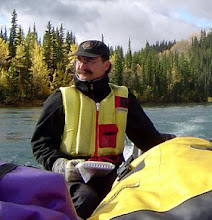
This summer there were many fires. In the last two days of our trip we paddled through still smoking forest.

Tuesday, August 27, 2013

Paddling the Upper Yukon 1: Tàa'an Män (Lake Laberge)

Landing at the Ta'an Kwach'an Council village of Upper Laberge. We've paddled 10 km, another 50 km of flat water paddling before we have the current carrying us again..
This summer I've been working the Road Scholar program (previously know as Elder Hostel) in the Yukon. These trips are relatively small groups of older adults wanting an edu-tourism experience. Ruby Range Adventure delivers the program employing me to provide introductory talks on Yukon history to their clients, a combination of hikers and paddlers. As part of the program I was able to join the last canoe trip of the season for their trip from Whitehorse to Carmacks, some 340 kilometers down river.

Upper Laberge village is beautifully located on the eastern shore of the lake. While no longer permanently occupied, Ta'an Kwach'an people are clearly working on maintaining the buildings and the site is regularly used by youth and Elders.
In the village I was fascinated to find the remains of one of the 1950s Indian Affairs matchbox houses. These "kits" were shipped throughout the north to provide basic - an understatement of astonishing dimensions - housing. Gavin Renwick notes that "The government house creates insulation from the land... a traditional lifestyle cannot be internally accommodated. (T)he separation of workplace and homeplace symbolizes an implicit cultural contradiction, the division of land from home."
Tàa'an Män, the Southern Tutchone name for Lake Laberge, is the centre of Ta'an Kwach'an traditional territory. There are few permanent residents along the lake. The west shore has a small scattered village of houses and some cottages and one family on the east shore is only accessible by boat. However, there are traditional campsites along both shores for fishing and hunting with trails connecting to the wider territory.
I have been on the lake in bad weather - it is a whole lot of not fun. But on our three day passage the lake is quiet and passive. We have a gentle southern zephyr every day except on our final leg on day three when the wind freshens and hastens our canoes into the mouth of the Thirty Mile River. At night the skies are clear and for those in our group who do not need sleep the Perseid meteor shower entertains.
We stop for lunch in a small bay, watching the cumulus clouds billow upwards in the hot weather. Southwards, behind us, we can see thunderstorms but above us only sunshine.
Marie, our guide, like the rest of us, feels the heat. We relax and just float beneath the endless sky. The lake goes on and on, not as challenge or task, rather as an experience. We paddle, because that's what you do in a canoe, but rather than making distance we simply watch the majesty of the landscape scroll by. Perhaps this is what heaven feels like.